
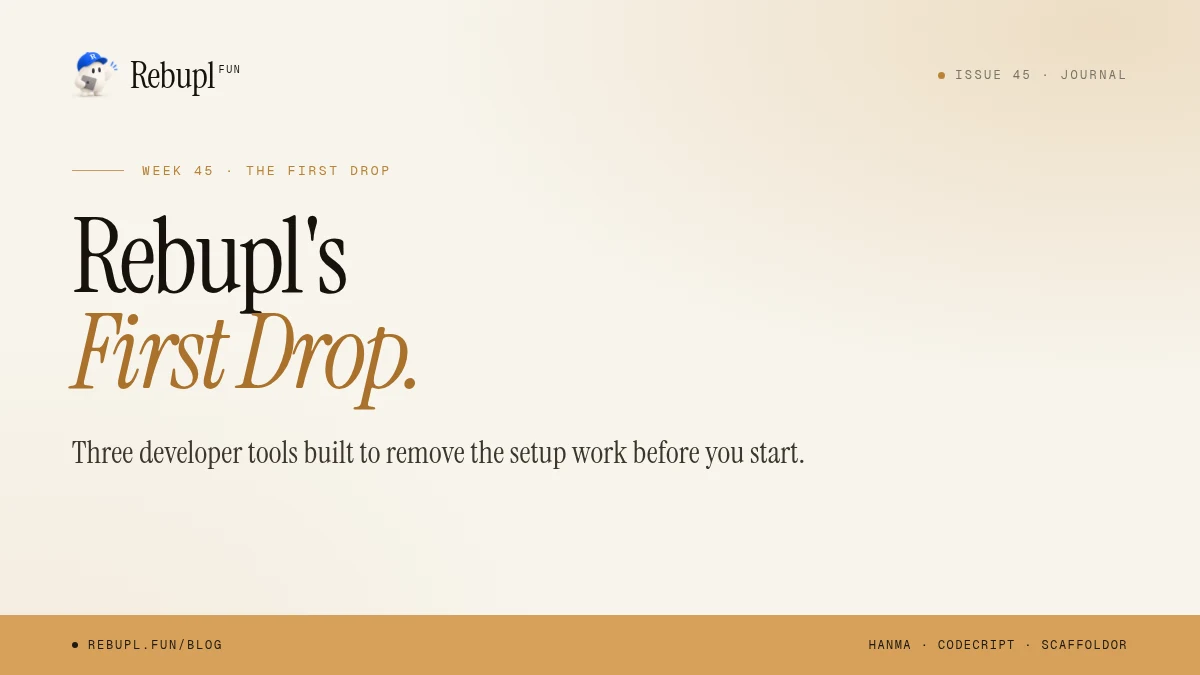
Week 45 was the first drop on Rebupl. Three products went live between November 2 and November 8, 2026, and all three were developer tools aimed at the same expensive moment: the blank page before a project starts.
That was not a coincidence. The first version of a product is mostly setup — choosing a framework, wiring a database, remembering how authentication works, finding the right learning resource, or recreating the same project structure for the fifth time. The tools in this drop attack that setup cost from three different directions.
Hanma: backend snippets you can own
Hanma is a snippet library and CLI for backend developers. Instead of installing another runtime dependency, you add the code you need directly to your project and keep it there.
The library covers the parts almost every backend needs: authentication, database clients, middleware, logging, CORS, error handling, and API utilities. It supports Express, Fastify, Hono, Elysia, and NestJS, with snippets available in TypeScript, Go, and Python.
The important design choice is ownership. A package gives you an API you have to work around. A snippet gives you code you can read, edit, and delete. For small teams and solo builders, that is often the difference between shipping this week and spending another evening reading documentation.
Hanma | Copy-Paste Backend Snippets for Node.jsProduction-ready backend snippets for Express, Fastify, Hono, Elysia, and NestJS. Authentication, database clients, middleware, and utilities2 upvotes · Developer Tools
Hanma is aimed at backend and full-stack developers, indie hackers building MVPs, and teams that want a consistent starting point without a heavy framework commitment. Its CLI makes the snippets discoverable and installable, but the output is still ordinary code in your repository — Git-friendly, reviewable, and easy to change.
Codecript: a reading library for engineering fundamentals
Codecript is an open-source, paper-inspired learning library for software engineers. It brings programming languages, data structures, algorithms, system design, low-level design, databases, API design, concurrency, DevOps, and testing into one structured place.
The format matters. Most technical learning is scattered across videos, half-finished blog posts, and interview-prep sites that optimise for memorisation. Codecript is closer to a set of well-organised notes: read the concept, see the explanation, and connect it to the next topic.
It also includes an interactive SQL playground with 64 exercises running PostgreSQL 17 in the browser. That gives the library a practice loop, not just a reading loop — which is exactly what most system design and database material lacks.
CodecriptLearn programming languages, data structures, algorithms, and system design with an open-source, paper-inspired reading library built for software engineers.2 upvotes · Developer Tools
Codecript is useful for students building fundamentals, developers preparing for coding and system design interviews, and experienced engineers filling gaps in databases, concurrency, or architecture. The paper-inspired presentation is a deliberate contrast to the dashboard-shaped tools the rest of the developer world has settled on.
Scaffoldor: start from a project that already works
Scaffoldor is a community-driven template registry and CLI. It helps you find a production-ready starter for a frontend app, backend service, or full-stack project, then initialise it without repeating the same setup steps.
The CLI handles the unglamorous parts: cloning the template, choosing a package manager, dealing with lockfiles, and creating a clean Git history. It works with GitHub, GitLab, and self-hosted repositories, and supports npm, pnpm, Yarn, and Bun. Templates can also be installed from a subdirectory, so one repository can hold several starters.
Scaffoldor — Production-ready project templatesDiscover and scaffold production-ready project templates from GitHub and GitLab. Browse by framework, copy one command, and start with a cle2 upvotes · Developer ToolsThe value is not just speed. Templates encode decisions — folder structure, tooling, configuration, and conventions — and those decisions are easier to inherit than to invent from scratch. Scaffoldor is aimed at indie hackers, startup teams, and developers who want to spend their first hour on the product rather than on project plumbing.
What the first drop had in common
Three products, three different surfaces, one shared premise: the beginning of a project should not be the hardest part.
- Hanma removes the cost of rewriting common backend code.
- Codecript removes the cost of finding structured, trustworthy engineering material.
- Scaffoldor removes the cost of recreating a project foundation.
They also show what a launch board looks like when it is just getting started. Week 45 had three launches, not thirty. The board was small enough to read in one sitting, and every product could be understood without a comparison table. That is a useful stage for a directory: the quality of the first entries sets the tone for everything that follows.
You can see the full drop on the Week 45 launch archive, or browse the live launch board to see what is shipping now.
Why publish a weekly recap at all?
A launch board is a snapshot. A recap is the argument around the snapshot: why these products matter, what they share, and what they say about the week they launched in.
That makes a post like this different from the archive page. The archive lists the launches. This article adds the context — the common problem, the design choices, and the parts of each product that are easy to miss from a tagline alone.
It also gives each product a second permanent link. Product pages are the source of truth; editorial coverage is how people who were not watching the board that week can still find them.
If you are building a developer tool and want to be part of a future drop, submit your product. The board is open, and the next launch week is already taking shape.
Frequently asked questions
What launched on Rebupl in Week 45?
Week 45, which ran from November 2 to November 8, 2026, featured three developer tools: Hanma, Codecript, and Scaffoldor.
What do Hanma, Codecript, and Scaffoldor have in common?
All three reduce the cost of starting. Hanma provides reusable backend snippets, Codecript provides structured engineering learning material, and Scaffoldor provides project templates and a CLI for initialising them.
How are products ranked on Rebupl?
Products are ranked by community upvotes. Paid launch tiers add distribution and placement, but they do not add votes. Click and view analytics are tracked separately.
Can I launch a developer tool on Rebupl?
Yes. You can submit a product from the launch page once you have claimed a builder handle. Launches are scheduled into weekly drops, and each launch gets a permanent product page.
