

Every launch day, the same message goes out. "We're live — would love your upvote. Send yours and I'll return it."
It is polite, it is reciprocal, and it is slowly making launch boards useless.
The board stops measuring products
A launch board has one job: tell a reader what is worth trying this week. Upvote-for-upvote changes the question. It is no longer "which of these is good?" but "whose founder has the most obliging friends?"
When ranking is reciprocal, the top of the board is not the best product. It is the best-organised founder. That is not a small distortion of the signal. It is the whole signal, gone.
This is Goodhart's law in a leaderboard: once the number becomes the target, it stops being a good number.
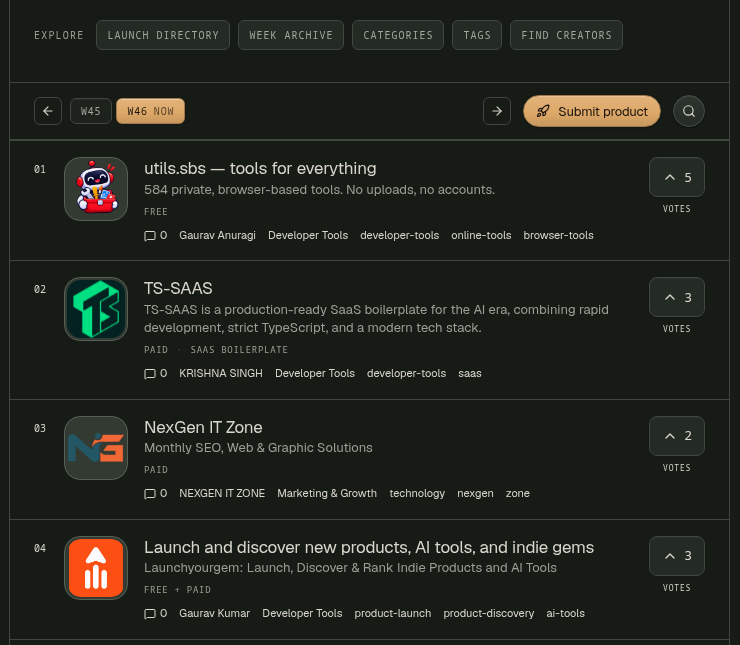
Readers figure this out faster than founders do. They see the same twenty products trading votes in the same group chats, and they stop treating the leaderboard as a recommendation. The board becomes a favour chart with a comments section.
What the founder actually wins
You spend launch day in DMs: chasing votes, returning votes, thanking people who voted, reminding people who said they would. You end the day with a rank and a number, and neither one ships with the product.
Platform analytics are not a business metric. Upvotes, impressions and rank tell you what happened on someone else's website. They do not tell you whether anyone activated, came back, or paid. You cannot deposit an upvote.
That is the trade nobody notices they are making. Launch day is the one day a founder has permission to talk to hundreds of potential users. Spending it on vote logistics swaps the valuable thing for the visible thing.
Why it keeps happening
It is a prisoner's dilemma. If everyone else is asking, not asking feels like bringing a spoon to a knife fight. Blaming individual founders is easy and useless; the incentive is the product, not their character.
The mechanics make it inevitable: public counters, weekly resets, a ranked board, one-click voting and no identity check. A board that counts clicks will get click behaviour. If the number can be moved by people who never opened the product, it will be.
Hacker News has asked people not to solicit upvotes for years, for the same reason. Its front page only works because a vote means someone found the link interesting.
A vote should be a person
At Rebupl we made a decision that is unpopular with growth-minded founders: only signed-in votes move the score. Anonymous votes are still recorded, but they are left out of the public number and the ranking. Here is how the count works. Paid placement is labelled and does not buy the top of the board; the comparison page spells that out. Disclosure: I run Rebupl, so weigh that however you like.
The rule changes behaviour more than it changes the count. You cannot ask a group chat to sign in with forty accounts as easily as you can ask for forty clicks. It does not eliminate reciprocity, but it pushes the cost of faking a launch above the cost of earning one. That is all a platform can really do.
Measure what leaves the platform
The more important shift is what a founder measures. Rank lives on the platform. Users leave it with you.
A launch that sends twenty people who sign up and come back is better than a top-three finish that sends a screenshot. Clicks, signups and week-two retention are the only scoreboards that survive the week. If those numbers are flat, the rank was decoration.
This is also the honest way to compare launch platforms. Not by how much traffic they promise, but by how many of their visitors turn into users you still have a month later.
What to ask for instead
Ask for feedback, not votes. Ask ten people to try the product and tell you where it broke. Ask the ones who do upvote to reply with one thing they would change. Publish the answers; they are more useful than the badge.
Bring people who have the problem, not people who owe you a favour. The founders who do well after launch are rarely the ones with the most obliging friends. They are the ones who used the attention to learn something.
The boards have to fix it
Founders cannot solve a collective action problem one DM at a time. Platforms have to make the number mean something: verified votes, a visible method, and outcomes shown next to the rank. Otherwise the leaderboard becomes a group project where everyone copies the same answer.
A launch board is only worth the traffic it sends if readers trust the ranking. That trust is the product. Upvote-for-upvote spends it for a screenshot.
Frequently asked questions
Is upvote-for-upvote against the rules?
Most platforms discourage it and few enforce it. It is usually not fraud in any legal sense; it is closer to cheating the reader. The tell is simple: if the people voting cannot describe what the product does, the vote was a favour.
Does it work in the short term?
Yes, which is exactly why it persists. A coordinated push can move you up the board for a day. It rarely produces users who stay, and it teaches you to optimise for the one metric that disappears when the week resets.
What should I ask for instead?
A try, a piece of feedback, or an introduction to someone with the problem. If the product is useful, an upvote is a side effect. If it is not, no number of upvotes will fix that.
If you want places where a launch still means something, start with the 26 directories I listed Rebupl on in the first ten days, browse the full launch directory, or read how upvotes are counted. If you are launching soon, start a free launch.
